1. Why did Paradise Hotel need to go digital?
How can a hotel increase revenue? Competition in Vietnam's hotel industry has never been fiercer. Even small hotels with 10–20 rooms face pressure from:
- Sharp price drops in low season
- Bookings that depend entirely on reception staff
- No control over availability, leading to missed opportunities
- OTAs such as Booking.com, Agoda and Traveloka becoming the main revenue source but hard to manage
- Booking mix-ups, overbooking and a lack of skilled staff
Paradise Hotel – a 3-star, 45-room hotel in the city centre – saw revenue fall steadily, with occupancy of only 45–55% despite a great location and competitive prices.

After months of research, the owner decided to automate booking management by synchronising OTAs with hotel management software (PMS + Channel Manager). The result: within three months, revenue rose 30%, occupancy reached 82% and operational errors fell to almost zero. Here is exactly how they did it.
2. The situation before OTA synchronisation
2.1 Reception updated rooms manually
For every Booking.com or Agoda reservation, staff had to read the email, write it in a book and mark availability or change prices – 3–5 minutes per booking, wasted time and frequent mistakes.
2.2 Frequent overbooking
If reception forgot to update one room on an OTA, two guests booked the same room, one arrived to find no room and left a 1-star review. In a single month, Paradise had six double bookings, costing VND 4 million in compensation plus lost guests.
2.3 No flexible pricing strategy
OTA prices change constantly with seasons and competitors, but Paradise kept fixed prices for 1–2 months at a time, missing profit.
2.4 No real-time room status
A guest arrives at 1 pm, the room isn't cleaned, reception calls housekeeping and the guest waits another 30 minutes.
2.5 No reports, no data
Without accurate data, the hotel couldn't forecast occupancy, adjust prices, manage revenue or optimise marketing.

3. The solution: synchronising OTAs through hotel management software
Paradise chose a solution combining:
- Hotel management software (PMS)
- A Channel Manager to synchronise OTAs
- A booking engine for direct bookings on the hotel website
- Real-time automatic updates of rates and availability
Why: 100% automated OTA handling, 90% fewer overbooking errors, Booking.com, Agoda, Traveloka and Airbnb managed together, easy to use and train, and good value for the results.
4. How OTA synchronisation works
When a guest books on an OTA such as Booking.com:
- The Channel Manager receives the booking
- The PMS automatically deducts the room
- Other OTAs close the room automatically to prevent duplicates
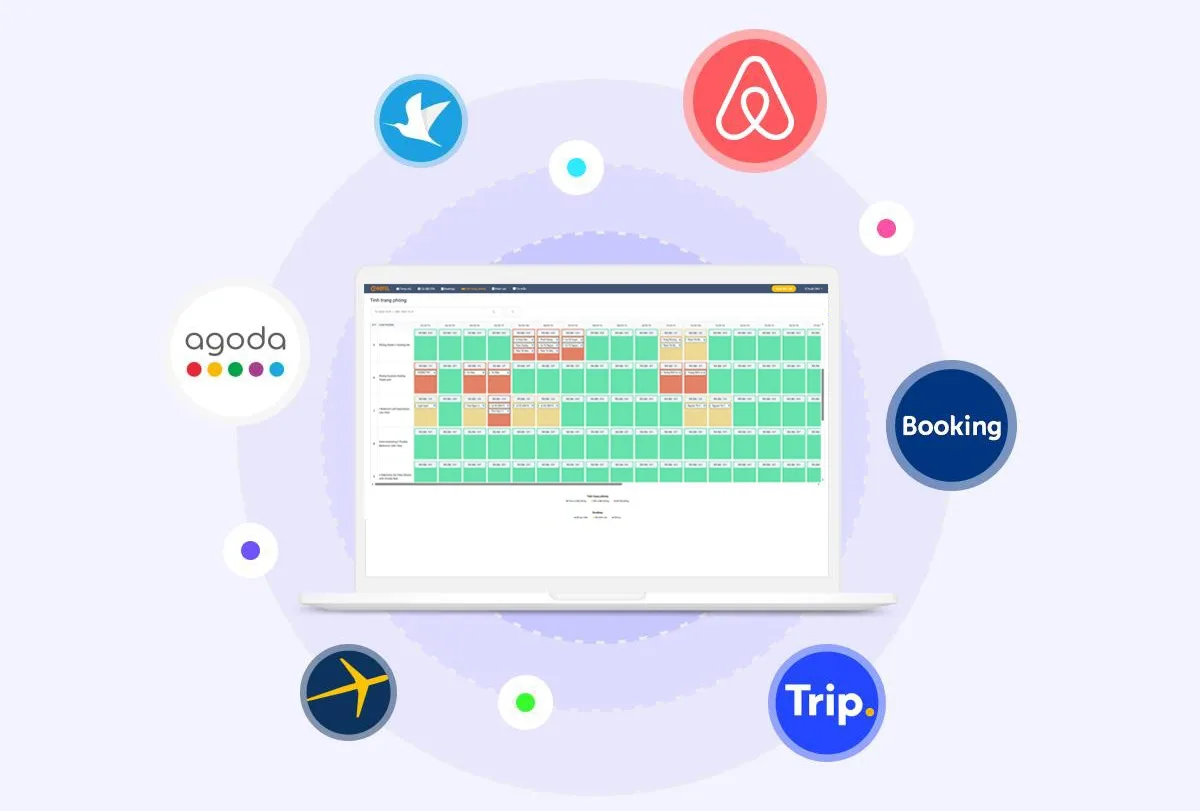
- Reception and the owner see it instantly on the room map
- The guest receives an automatic confirmation email
- Data is recorded for occupancy reports
When a guest cancels, the room reopens on all OTAs automatically. A task that used to take reception five minutes now takes the system one second.
5. The process Paradise used to increase revenue by 30%
5.1 Standardise OTA content
Update all photos, rewrite room descriptions, optimise room titles for OTAs, add check-in/check-out policies and create packages (weekend deals, long stays, 3-night combos). Content optimisation alone increased room views by 15%.
5.2 Connect PMS, Channel Manager and OTAs
The most important step. Afterwards, prices were consistent across the system, room calendars synced in real time and manual entry – and its errors – disappeared.
5.3 Apply dynamic pricing
Paradise set rules such as +20% in peak season, automatic increases on Fridays and Saturdays, +15% when fewer than 5 rooms remain and –10% when occupancy falls below 40%. Weekday occupancy rose strongly and average daily rate (ADR) increased by 12%.
5.4 Activate a booking engine for direct bookings
With a booking engine on the website and Facebook page, guests can see real-time availability and book directly at a lower price than OTAs, saving the hotel 15–20% commission. Direct bookings rose from 5% to 20%.
5.5 Automate guest communication
Automatic confirmation emails, directions, check-in reminders and post-stay review requests raised the Booking.com score from 8.4 to 9.1.
5.6 Internal control
The owner uses reports on occupancy by day, week and month, total OTA revenue, direct booking revenue, best-selling rooms, most effective OTAs, ADR and revenue handled per receptionist – enabling more accurate strategy.
6. Results after three months
- Revenue up 30%: occupancy from 55% to 82%, ADR up 12% and far fewer empty rooms in low season
- 95% fewer overbooking errors: the system handles everything automatically
- Two fewer receptionists per shift: saving about VND 12–15 million per month
- Higher OTA ratings: Booking.com 8.4 → 9.1, Agoda 7.9 → 8.8
- 15% more direct bookings thanks to the booking engine and better prices
- Transparent reports and no leakage: all figures on one screen
7. Why OTA synchronisation is so effective
7.1 Real-time market pricing
Track competitors, adjust prices and win more bookings.
7.2 More visibility
OTAs favour hotels that respond quickly, have low cancellation rates, high ratings and flexible pricing.
7.3 Lower staff costs and fewer errors
Paradise saves around VND 180 million a year.
7.4 Better reputation and guest experience
Zero overbooking → happy guests → high ratings → more visibility.
8. Software features behind Paradise's success
- A visual, colour-coded room map
- A Channel Manager connecting 30+ OTAs (Booking.com, Agoda, Traveloka, Airbnb, Expedia…)
- Rule-based dynamic pricing
- A 0% commission website booking engine
- Room and OTA history for accurate complaint handling
- Detailed revenue reports by day, week, month, OTA and staff
- Automatic emails and messages
9. The standard model for hotels that want to grow like Paradise
PMS + Channel Manager + Booking Engine → automation → lower costs → higher revenue → less dependence on staff → no more errors.
10. Conclusion: OTA synchronisation is the key to sustainable growth
Paradise's story is not unusual – most hotels using a PMS with a Channel Manager report revenue growth. If your hotel suffers from low occupancy, long periods of empty rooms, slow updates by reception, bookings lost to competitors, frequent overbooking or unclear reports, OTA synchronisation is the step you need.